Decision Impact Lag: Why Results Take Years to Be Seen
The Moment of Announcement and the Reality That Follows
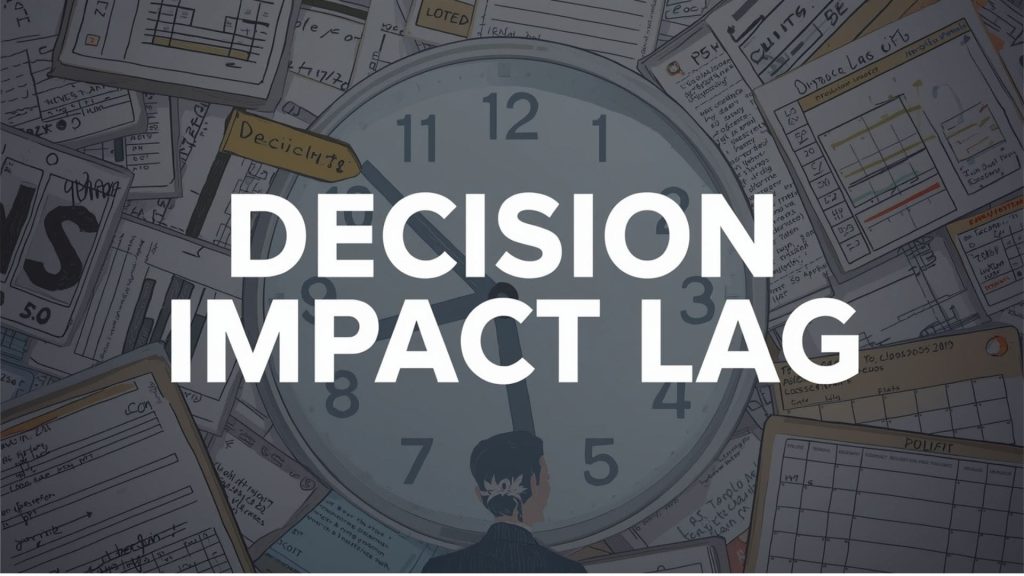
In many institutional environments, observers often assume that once a major directive is announced, visible results should follow soon after. The announcement moment carries emotional weight, media visibility, and symbolic meaning. Yet the practical effects rarely appear quickly. Institutions operate through layered structures, shared responsibilities, interpretation processes, and resource coordination. Understanding why outcomes take time requires examining how a directive moves through these layers before becoming part of daily practice.
A leadership choice may begin as a clear direction at the top, but clarity in principle does not guarantee immediate clarity in execution. Implementation requires translation into procedures, communication adjustments, and sustained commitment. These processes are gradual by nature, not instantaneous.
Information Is Never Complete at the Moment of Decision
Even well-prepared leadership teams must work with limited information. Data evolves. Context shifts. Forecasts carry uncertainty. When a Decision is made under pressure, the balance between caution and responsiveness becomes difficult. This is not a matter of hesitation or weakness. It is an inherent challenge of acting under imperfect knowledge.
Media environments accelerate expectations. News platforms such as https://edition.cnn.com/ highlight announcements, turning them into immediate focal points. The public sees the moment of declaration but not the extensive internal work that follows. This creates the impression that a Decision is the endpoint rather than the starting point of a much longer sequence.
Coordination Across Layers of Responsibility
Institutions do not function as single organisms. They are networks of teams, offices, departments, and individuals with different roles and priorities. For a Decision to have meaningful effect, each layer must interpret and adopt the direction consistently. If alignment is weak, the Decision becomes symbolic rather than functional.
This is why internal communication is crucial. If the rationale behind a Decision is explained clearly, adoption becomes easier. If messaging is vague, slow, or inconsistent, different groups may follow different interpretations, reducing effectiveness.
Historical Memory Shapes How New Decisions Are Received
Organizations do not operate in a vacuum. They carry memory. Previous successes build confidence. Previous failures create hesitation. When a new Decision is introduced, staff and stakeholders interpret it through the lens of past experience. If similar changes were previously attempted and abandoned, skepticism may slow momentum. If previous directional shifts brought improvement, alignment may accelerate.
This memory-based filtering often determines the difference between quick adoption and cautious distance. The Decision is the same, but the reception changes based on history.
The Role of External Pressure and Public Expectation
A Decision does not live only inside institutions. It exists in public view, where perception shapes legitimacy. Media framing influences how strongly people believe a Decision will matter. When coverage focuses on dramatic moments or conflict, expectations rise. When results do not match emotional anticipation quickly, criticism grows.
This dynamic can pressure leadership to accelerate timelines, even when the groundwork is not complete. Rushing implementation can damage long-term outcomes. A Decision that appears fast can ultimately become less effective if the foundation beneath it is unstable.
Learning From Collective Adaptation in Nature
Patterns of adaptation in natural systems illustrate this lag clearly. Observing animal group coordination on platforms such as https://zoopora.com/ shows how change spreads gradually through signaling, learning, and shared adjustment. No single command creates total transformation. Change emerges through repeated alignment.
Institutions behave similarly. A Decision initiates direction, but the transformation occurs through accumulated shifts in daily routines, communication flows, and collaborative habits.
Implementation Is Where Meaning Becomes Real
A Decision written in a document or announced in a speech does not improve outcomes by itself. Implementation is the stage where the direction is turned into action, monitoring, evaluation, and revision. Teams must rewrite workflows, create support materials, train staff, and establish milestones. Without these steps, even a strong Decision loses force.
This stage requires time not because institutions are resistant, but because transformation is cumulative. Systems stabilize through repetition, reinforcement, and correction. A Decision becomes real through practice.
The Weight of Resources and Practical Capacity
An ambitious Decision means little if the resources required to enact it are not available. Budgets, staffing, timelines, and infrastructure determine how fast change can occur. A direction may be principled and well-intended, but without material capacity, implementation will be slow or incomplete.
Effective leaders recognize that producing a Decision is only the first component. Renewing structures and allocating support are equally necessary.
Why Results Are Slow by Design
The delay between a Decision and visible outcomes is not always a flaw. It can be a stabilizing function. Rapid shifts can destabilize institutions, undermine trust, and create inconsistency. Slow and steady progress allows adjustment, learning, and improvement along the way.
This pace allows organizations to reduce mistakes, correct course with evidence, and maintain continuity while evolving.
Conclusion
The moment of a Decision is not the conclusion of a process, but the beginning of one. The visible result depends on layered coordination, careful communication, organizational memory, resource distribution, and time. When expectations align with the real pace of structural change, outcomes become more durable and meaningful.
For further commentary, reflective writing, and analytical discussion, readers can explore related perspectives at https://politicxy.com, where long-form reflection offers a deeper understanding of institutional dynamics.
The Pulse of Movies

Sanctions Policy As A Non Military Tool Of Pressure

Information Warfare In Politics And The Fight For Truth

Democratic Backsliding, Early Warning Signs To Watch

Policy Experiments Tested Locally Before National Adoption